Wednesday, February 27, 2013

Immanuel Kant and his Man-Servant Lampe

Very interesting blog on the end of Kant's life and his relationship to his man-servant, Lampe. Most of the information comes from Ehregott Andreas Wasianski's 1804 work, Immanuel Kant in seinen letzten Lebensjahren.
Wasianski pauses to describe the relationship between the two in some detail. He considers it important to do so, since Kant and Lampe had a falling out two years before the philosopher's death. The nature of the dispute is not entirely clear from what Wasianski is willing to report of it, but it leads to the servant's dismissal, in 1802, and inaugurates the period of Kant's decline and eventual death two years later.
Immanuel Kant and his Man-Servant Lampe - Justin Erik Halldór Smith

Monday, February 25, 2013

Can pills change our morals?

Molly Crockett
Could we change the way people respond to moral situations by manipulating their brain chemistry with antidepressant pills? Molly Crockett is a neuroscientist investigating this question.
It seems that if we can just wrap our heads around the idea that peoples’ attachment to their ideals is not fixed, but can change, we’re more likely to listen to each other. It’s unclear whether we will ever be able to create a “morality pill”—in part because we have yet to reach consensus on what is “moral” in the first place.4 And we still have a long way to go before we fully understand how brain chemistry shapes moral judgment and behaviour.5 But preliminary work suggests we ought to cultivate a healthy skepticism towards our own sense of right and wrong – it may well be vulnerable to factors below our awareness and beyond our control.
Can pills change our morals? | thInk

Sunday, February 24, 2013

Bertrand Russell on science, education and democracy

Bertrand Russell
Bertrand Russell contends that "science education — something that leaves much to be desired nearly a century later — is key to attaining a future of happiness and democracy." In his 1926 book Education and the Good Life Russell writes about the good life, science, democracy and the importance of education.

For the first time in history, it is now possible, owing to the industrial revolution and its byproducts, to create a world where everybody shall have a reasonable chance of happiness. Physical evil can, if we choose, be reduced to very small proportions. It would be possible, by organization and science, to feed and house the whole population of the world, not luxuriously, but sufficiently to prevent great suffering. It would be possible to combat disease, and to make chronic ill-health very rare. … All this is of such immeasurable value to human life that we dare not oppress the sort of education which will tend to bring it about. in such an education, applied science will have to be the chief ingredient. Without physics and physiology and psychology, we cannot build the new world.

Bertrand Russell on human nature, construction vs. destruction, and science as a key to democracy | Brain Pickings

Wednesday, February 20, 2013

Philosophers' Cafe Topic: Gun Violence

“Gun Violence: A Philosophical Debate” is our topic at the next Philosophers' Cafe. Friday, February 22, 3:00-4:00 in GH 316.

Friday, February 15, 2013

Consciousness Conference Online

Are you  interested in the philosophy of mind and the nature of consciousness? You might want to check out this online conference. It begins February 15 at noon. You can browse the papers and the comments, including the activity from previous conferences.
The conference begins on the third Friday in February and runs for two weeks (that being ‘the conference’). Those presenters who allow it have their papers posted online at least a week before the conference begins so that people can read as many papers, in as much detail, as they choose beforehand to enhance and deepen discussion. During this two weeks discussion takes place in the comments section of each session (i.e. each post). It is much like blogging, only during a specific two week period. As such it can be done from anywhere at any time! After the conference the comments section will be closed (unless requested to be left open by author). Presentations, videos, papers, etc and discussion are left for people to view (unless the presenter requests otherwise) but no new comments are approved.
Consciousness Online

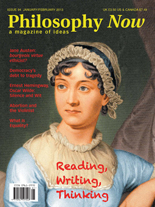
Was Jane Austen a Moral Philosopher?

Was Jane Austen a moral philosopher? Thomas Rodham thinks so. 
Jane Austen (1775-1817) wrote delicious romantic comedies about middle-class girls looking for good husbands among the landed gentry of Regency England. But if that were all there was to it we wouldn’t take her any more seriously now than the genre hacks published by Mills and Boon. What’s so special about her novels that we are still reading them today? It’s not just their literary quality. Austen was also a brilliant moral philosopher who analysed and taught a virtue ethics for middle-class life that is surprisingly contemporary. Appreciating this can help us understand why she wrote the way she did, and how and why we should read her today.
Reading Jane Austen as a Moral Philosopher | Issue 94 | Philosophy Now

Thursday, February 14, 2013

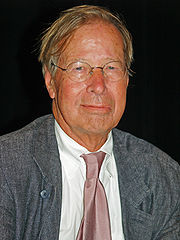
Ronald Dworkin

Ronald Dworkin
The legal philosopher and scholar Ronald Dworkin passed away at age 81. Dworkin made important contributions to the philosophy of law and political philosophy.
His theory of law as integrity, in which judges interpret the law in terms of consistent and communal moral principles, especially justice and fairness, is amongst the most influential contemporary theories about the nature of law. He advocates a "moral reading" of theUnited States Constitution,[4] and an interpretivist approach to law and morality. (Wikipedia)

Sunday, February 10, 2013

Saturday, February 02, 2013

Should You Kill The Fat Man?

Try this thought experiment at The Philosopher's Magazine:
This activity is a treatment of some of the issues thrown up by a thought experiment called 'The Trolley Problem', which was first outlined by the philosopher Philippa Foot, and then developed by Judith Jarvis Thomson and others. But before we start properly, we need to ask you four preliminary questions so we get a sense of the way that you think about morality.
Should You Kill The Fat Man?

Friday, February 01, 2013

Minority Report

The Film and Philosophy series will screen and discuss Steven Spielberg's Minority Report on Friday, Feb. 8, from 3:00-6:00 in the Digitorium. Please join us!
For more information about the film see:

Thursday, January 31, 2013

Philosophy Student Conference

Fifth Annual Philosophy Student Conference

This is the call for papers for the fifth annual Philosophy Student Conference at the University of Georgia. The conference will be held at Peabody Hall, University of Georgia, Room 115 on Saturday, March 30th. (phone(706)-542-2823). The deadline for submissions is March 9th. Following the deadline, all submissions will be reviewed and selections will be made, with notifications sent to all no later than Saturday, March 16th, 2012. It is the committee's intent to accommodate as many of the student papers submitted as possible. Papers will be followed with discussion.

Paper Submission Guidelines:
  • The colloquium is open to any undergraduate student. Papers submitted can be on any topic of serious philosophical concern and are to be between a minimum of 1, 500 words and a maximum of 3,000 words.
  • Please prepare paper for blind review. Include cover letter and provide no identifying information in paper.
Submissions should be sent by e-mail attachment (word document) to:
ugaphilosophyclub@gmail.com

Phi Sigma Tau-University of Georgia Chapter

An Interview with Philosopher Hilary Kornblith

3:AM: What made you become a philosopher? Has it turned out to be what you imagined? 
Hilary Kornblith
Hilary Kornblith: When I was in high school, I read a lot of existentialist novels and plays – Dostoevsky, Camus, Sartre – and I went on from there to read Nietzsche and some of Sartre’s essays and Being and Nothingness. When I got to college, I planned to be a math major, and, in addition to signing up for some math courses, I decided to take some philosophy. Quite by chance, I took a philosophy of science course in which the entire semester was devoted to reading Locke’s Essay. I was hooked. For the next few semesters, I took nothing but philosophy and math courses, and it wasn’t long before I realised that it was the philosophy that really moved me. I don’t know whether I can say that having a career in philosophy has turned out as I imagined, since in many ways I had little idea of what such a life would be like. But philosophy is still tremendously exciting to me, and the opportunity to think, and talk, and write about these issues has been wonderful.
On reflection: Interview with Hilary Kornblith » 3:AM Magazine

Wednesday, January 30, 2013

The Right to Bear Arms?

Do you have a right to own a gun? Take the poll below.

Be sure to attend our Philosophers' Cafe on February 22 when discuss Gun Violence

Friday, January 18, 2013

The Normal Well-Tempered Mind

Dan Dennett talks about "selfish neurons" and the well-tempered mind.
Dan Dennett
We're beginning to come to grips with the idea that your brain is not this well-organized hierarchical control system where everything is in order, a very dramatic vision of bureaucracy. In fact, it's much more like anarchy with some elements of democracy. Sometimes you can achieve stability and mutual aid and a sort of calm united front, and then everything is hunky-dory, but then it's always possible for things to get out of whack and for one alliance or another to gain control, and then you get obsessions and delusions and so forth. 
You begin to think about the normal well-tempered mind, in effect, the well-organized mind, as an achievement, not as the base state, something that is only achieved when all is going well, but still, in the general realm of humanity, most of us are pretty well put together most of the time. This gives a very different vision of what the architecture is like, and I'm just trying to get my head around how to think about that.
THE NORMAL WELL-TEMPERED MIND | Edge.org

Monday, January 14, 2013

Philosophy Movies

The Film and Philosophy series continues this spring the second Friday of each month at 3:00 in the Digitorium.


Female Philosophers Shake Up Their Field

Philosophy has been slow to change:
Most philosophy departments and conference meetings are still saturated with men. More than 80 percent of full-time faculty members in philosophy are male, compared with just 60 percent for the professoriate as a whole, according to 2003 data compiled by the U.S. Education Department, the latest available.
But it is changing.
Ms. Alcoff [President of the Eastern Division APA] and other women say that despite the overwhelmingly male nature of their discipline, faculty members picked her as president in part because those who vote in the association's elections are more likely than others to endorse change, and because the association's nominating committee assembled a diverse slate of presidential candidates, including a black male and two feminist philosophers. "One of my goals is to increase diversity," Amy Ferrer, the association's new executive director, told The Chronicle.
At NKU about 25% of our majors are female. And only one of our five tenured faculty is female. We have few opportunities to hire new faculty, but we can do more to attract more female majors and minors.  Any suggestions?

We will offer PHI 311 Philosophy of Woman in the fall. Look for it.

Female Philosophers Shake Up Their Field - Faculty - The Chronicle of Higher Education (Firewall)

Wednesday, January 09, 2013

Are Babies Born Good?

"New research offers surprising answers to the age-old question of where morality comes from"


Are Babies Born Good? | Science & Nature | Smithsonian Magazine

Tuesday, January 08, 2013

Knowledge, Innovation, and Integration (in Philosophy)

Here's an interview video we made with Integrative Studies last year. The topics included generating knowledge within philosophy, innovation and integration.


The best books of 2012 from The Philosophers Magazine

There are some good books on this list.
With 2012 safely behind us, we ask TPM’s reviewers to select a favourite book published last year (give or take a few months), taking into account our commitment to the twin virtues of philosophical rigour and readability. As a slightly late stocking stuffer, we offer you this rich, juicy and still mildly festive list of philosophy books which are both illuminating and enjoyable.
The best books of 2012 | The Philosophers Magazine