Saturday, November 29, 2014

Margaret Cuonzo Talks About Paradoxes

Margaret Cuonzo
Margaret Cuonzo talks about paradoxes, philosophy and more.
The sorites is, to my mind, one of the deepest paradoxes out there and it provides a good example for understanding different ways to solve paradoxes. It is very deep because the premises of the paradox are close to certainly true, the reasoning is straightforward, and yet the conclusion is obviously false. In addition, the phenomenon that gives rise to the paradox, namely the vagueness of language, is so ubiquitous that the paradox has implications for much of our language. It tells us a lot about the concepts that we use everyday. The vast majority of our concepts, those like, baldness, wealth, strength, nearness, and so on, are vague. These admit of borderline cases and this can lead to outright contradiction. One fascinating thing about the sorites, then, is that it exposes how perfectly useful concepts lead to contradiction.
3:AM Magazine by Richard Marshall

Friday, November 28, 2014

Religious Studies Courses for Spring 2015

Check out the spring 2015 courses for the Religious Studies minor. And note the KIIS summer semester in Greece!


The Is-Ought Problem

From the BBC4 series on the History of Ideas: The Is-Ought Problem. "Do you draw conclusions from how things are to think about how things should be? There might be a gap in your reasoning."

Companions in Misery [or "Happy Together"]

On being miserably happy:
[Schopenhauer's] account of others as “fellow-sufferers” in “On the Sufferings of the World” encourages us to nurture a soft spot for even the most flawed individuals. That we are all condemned to the same Sisyphean fate ought to make us compassionate instead of competitive, work together instead of in isolation, and rely on one another instead of just ourselves. While Camus, in his well-known essay on the myth, has Sisyphus suffer his punishment alone, Schopenhauer’s account of redemption through shared misery might give Sisyphus, and us, neighbors to love. Still, Camus concludes, “One must imagine Sisyphus happy.” And if Camus can imagine happiness for a man sentenced to an eternity of meaningless toil, perhaps we can do the same for dissatisfied New Yorkers. Whether we are grieving the death of a friend or complaining about alternate-side-of-the-street parking, I think Schopenhauer was right to call us “companions in misery,” with the emphasis on companions.
From New York Times, The Stone, Companions in Misery By Mariana Alessandri

Runaway Trolley: Pragmatism is Not Welcome!


From Saturday Morning Breakfast Cereal

Friday, November 21, 2014

Morality is the key to personal identity

‘Know thyself’ is a flimsy bargain-basement platitude, endlessly recycled but maddeningly empty. It skates the very existential question it pretends to address, the question that obsesses us: what is it to know oneself? The lesson of the identity detector is this: when we dig deep, beneath our memory traces and career ambitions and favourite authors and small talk, we find a constellation of moral capacities. This is what we should cultivate and burnish, if we want people to know who we really are.
Morality is the key to personal identity – Nina Strohminger – Aeon

Wednesday, November 19, 2014

Essay Contest

Essay Contest
Attention philosophy students: Please consider submitting something to this essay contest. Take a paper you wrote for a course in a previous semester or a paper you're writing now. Philosophy faculty would be happy to work with you to polish it for the contest.

Saturday, November 15, 2014

Ethics Bowl 2014

Congratulations to this year's Ethics Bowl team. Ted Hays, Courtney Knox, Christian Willett, Leighann Goins, Ryan Frye and Marc Kennedy competed in Marion, IN recently. They did a great job, ranking 12th and ahead of some very good schools. Thanks to Dr. Yaw for helping prepare the team.

Friday, November 14, 2014

Thursday, November 06, 2014

Viva Humanities Student Symposium

Philosophy students: please consider participating in this Viva Humanities event at NKU in the spring. If you have an idea for a paper or presentation, you can contact any of the program faculty for advice and help.
As part of NKU’s goal to cultivate transdisciplinary inquiry, the Viva Humanities committee invites students to participate in the Viva Humanities Student Symposium showcasing students’ critical and creative endeavors. 
We welcome proposals from diverse disciplines to consider the question “What does it mean to be human in a digital world?” The format for delivery may be a talk, a paper or poster presentation, a reading of creative writing, a discussion of an original art piece, or a digital performance or presentation. Topics for consideration may include (but are not limited to):
  • Impact of technology, digital media, and/or social media on relationships 
  • Arts, film, and literature in the digital world
  • Artificial intelligence 
  • Impact of technology on medicine
    Impact of technology on relationships between countries and cultures 
  • How technology brings the world, countries, and/or people closer together (or further apart) 
  • How technology affects the relationship of humans and the environment/nature
    How technology impacts the environment 
  • Ethical questions related to technology or digital media 
The Symposium will be a one day event on NKU’s campus that will include student panels and poster sessions. We solicit proposals for brief (5 minutes) roundtable presentations that approach our question from a “humanities” perspective. According to the National Foundation on the Arts and Humanities Act from 1965:

The term 'humanities' includes, but is not limited to, the study and interpretation of the following: language, both modern and classical; linguistics; literature; history; jurisprudence; philosophy; archaeology; comparative religion; ethics; the history, criticism and theory of the arts; those aspects of social sciences which have humanistic content and employ humanistic methods; and the study and application of the humanities to the human environment with particular attention to reflecting our diverse heritage, traditions, and history and to the relevance of the humanities to the current conditions of national life. 
Deadline for Abstracts: February 13, 2015"


Viva Humanities: Northern Kentucky University

Tuesday, October 28, 2014

Spring 2015 Schedule

The Spring 2015 schedule is available. Philosophy majors who need to make an advising appointment should contact Rudy Garns (garns@nku.edu) or make an appointment online.

Wednesday, September 03, 2014

Cultural Evolution

Last May, Daniel Dennett gathered, at the Santa Fe Institute, a handful of people who have written about cultural evolution. The general impression was that (as he tweeted some time later) "the meeting revealed a lot of unexpected common ground".
Summaries from participants available here.

Thursday, August 21, 2014

Why A Philosopher Teaches Privacy

While privacy education requires philosophical insight, relevant philosophical analysis must be applied to constantly shifting technological, social, legal, and political conditions.
Why A Philosopher Teaches Privacy

Saturday, August 16, 2014

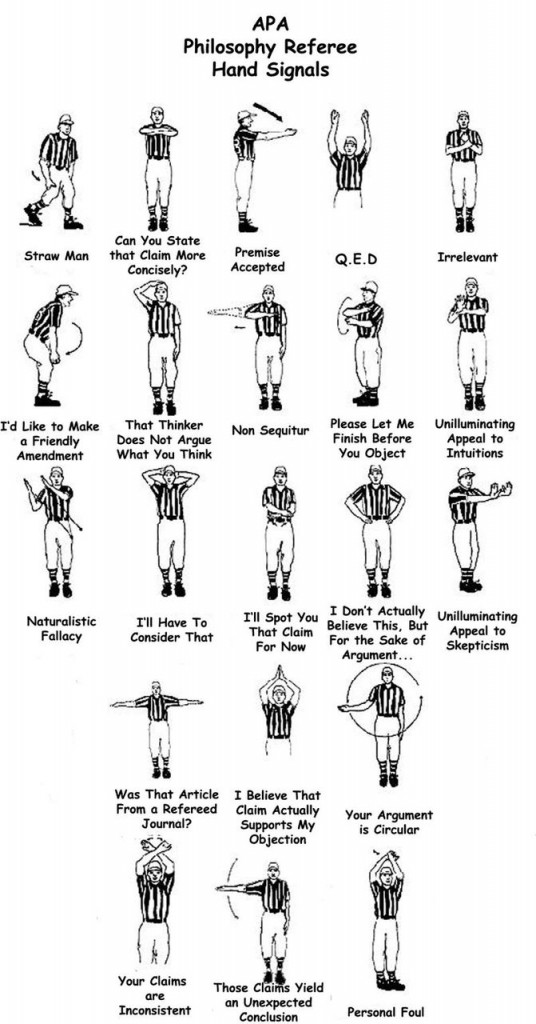
Philosophy Referee Hand Signals

"The next time you’re presiding over an intense philosophical debate, feel free to use these hand signals to referee things. "

Thursday, August 14, 2014

Philosophy and Science: Double Team? » IAI TV

So even before we get to the ethics and the politics, I would say right from the very beginning, science and philosophy are intertwined. Philosophers need to keep pointing that out.
Philosophy and Science: Double Team? 


'via Blog this'

Don’t Dismiss the Humanities

Nicholas Kristof of the NY Times writes
So let me push back at the idea that the humanities are obscure, arcane and irrelevant. These three philosophers influence the way I think about politics, immigration, inequality; they even affect what I eat. 
It’s also worth pointing out that these three philosophers [Berlin, Singer, Rawls] are recent ones. To adapt to a changing world, we need new software for our cellphones; we also need new ideas. The same goes for literature, for architecture, languages and theology.
Don’t Dismiss the Humanities

The humanities strengthen the study of science

Elizabeth H. Simmons, dean of Lyman Briggs College, acting dean of the College of Arts and Letters, and University Distinguished Professor of Physics at Michigan State University, writes about the value of a humanities education for scientists.
In the end, Cushing’s brain collection vividly reminds us why it is crucial to immerse natural science students in interdisciplinary science studies that incorporate the social sciences and humanities. It is not merely because hot new fields are said to lie at the unexplored intersections of fields whose borders were arbitrarily codified decades or centuries ago (though that is true). It is not merely because the terms interdisciplinary, cross-disciplinary, and trans-disciplinary are presently in vogue (though that is also true). It is because such cross-training produces scientists who are both more capable of extraordinary breakthroughs and more mindful of their broader impacts. The humanities truly strengthen science.
The humanities strengthen the study of science

Tuesday, May 27, 2014

Undergrad Philosophy & Religion CFPs

A nice blog that posts call for papers for undergraduate philosophy conferences.


Undergrad Philosophy & Religion CFPs


Wednesday, May 21, 2014

On human nurture | The University of Chicago Magazine

Jesse Prinz
Profile of philosopher Jesse Prinz.

Prinz’s work, which one of his CUNY colleagues applauds as “intellectually promiscuous,” draws on philosophy, cognitive neuroscience, experimental psychology, and other disciplines to explore the ways humans have moved beyond that reptilian origin. Prinz has written a lot, all of it united by an uncompromising empiricism—his position that our diverse sensory and cultural experience, varying from person to person and place to place, is the ultimate foundation for our concepts, conjectures, and knowledge. “The study of the human mind,” he has written, “is fundamentally the study of place.” In other words, nurture over nature. “The headline news in telling our story,” he says, “is in telling the story of learning and change.”
On human nurture | The University of Chicago Magazine

Philosophy student wins on The Voice

Philosophy student Josh Kaufman wins on The Voice. He's taking a break from studying philosophy at Northern Illinois University.