Tuesday, May 07, 2013

The Philosophy of Kierkegaard

Soren Kierkegaard
A 1984 documentary on existentialist philosopher Soren Kierkegaard.
Danish philosopher Søren Kierkegaard—often considered the first existentialist—was born 200 years ago this past Sunday in Copenhagen. Writing under pseudonyms like Johannes Climacus and Johannes de Silentio, Kierkegaard attacked both the idealism of contemporary philosophers Hegel and Schelling and the bourgeois complacency of European Christendom. A highly skilled rhetorician, Kierkegaard preferred the indirect method, deploying irony, ridicule, parody and satire in a paradoxical search for individual authenticity within a European culture he saw as beset by self-important puffery and unthinking mass movements.
The Philosophy of Kierkegaard, the First Existentialist Philosopher, Revisited in 1984 Documentary | Open Culture

Saturday, May 04, 2013

Why Study Philosophy?

Why study philosophy? It prepares you for well-paying jobs. It's interesting. It's great preparation for law school, business school or graduate school. The USC philosophy department has gathered some interesting data.

Undergraduate > School of Philosophy

Wednesday, May 01, 2013

Daniel Dennett, ‘Intuition Pumps and Other Tools for Thinking’

Dan Dennett
Dan Dennett has written a new book about thought experiments, imagination, and the art of doing philosophy.
“Philosophers are infamous for being navel-gazers, but a lot of them are remarkably unreflective about their own methods.” He added, “If you do get a little self-conscious, it opens up so many weak spots and helps you think.”
Daniel Dennett, Author of ‘Intuition Pumps and Other Tools for Thinking’

Monday, April 29, 2013

Ethics and the Limits of Evolutionary Psychology

Interesting essay on the state of naturalized ethics and the influence of evolutionary psychology.

"Wittgenstein sums this up for us: 'if I want to fix my mind on what I mean by absolute or ethical value…I wonder at the existence of the world.'"

IASC: The Hedgehog Review - Volume 15, No. 1 (Spring 2013) - Ethics and the Limits of Evolutionary Psychology - Thomas de Zengotita

Wednesday, April 17, 2013

the possible worlds hedgehog

Philosopher Robert Stalnaker is interviewed at 3amMagazine.
Robert Stalnaker is the grandmaster flash of contemporary metaphysicals. He thinks that a language-first approach to philosophy is ludicrous, Paul Grice an inspiration and Saul Kripke very important to his early thinking. He broods on issues about internalist and externalist doctrines and approaches, on our knowledge of the external world, about the nature of phenomenal knowedge, about the view from nowhere, the opacity of transparency, contextualism, relativism, possible worlds, the entanglement of semantics with metaphysics, haecceitism and the beauty of metaphysical theories, amongst other things. He is currently on a phased retirement at MIT and becoming a Visiting Professor at Columbia. He is simply a modern daddy of the mac!Chillin’!
the possible worlds hedgehog » 3:AM Magazine

Monday, April 01, 2013

On the benefits of a philosophy major

Philosophy majors are regularly exposed to critical thinking and analysis. They have skills that make them very attractive on the job market.
Thus it is not a surprise (at least to me!) that philosophy majors are some of the best with regard to analytical skills, evidenced by the above graphic. According to the Educational Testing Service, which administers the GRE, the analytic writing section tests “critical thinking and analytical writing skills. It assesses [your] ability to articulate and support complex ideas, construct and evaluate arguments, and sustain a focused and coherent discussion.” Philosophy majors are also the best with regard to verbal ability, and the best of the liberal arts students at quantitative reasoning. Simply put, our students have the best all-around intellectual skills.
On the benefits of a philosophy major | Pleas and Excuses

Monday, March 25, 2013

The Ironic Success Of Experimental Philosophy

What is experimental philosophy? They are getting a lot of press and making some interesting observations.
Practitioners of experimental philosophy ("X-Philes") are a heterogeneous bunch, but most believe that there are important limitations to philosophy's dominant "armchair" methods of reflection and argumentation, prompting the adoption of a burning armchair as a logo (you can hear the accompanying anthem, sung by Alina Simone, on YouTube). To explore and remedy these limitations, they have turned to psychological research on people's judgments, feelings and behaviors. Some of them conduct this research themselves; others collaborate with social scientists or draw upon their work.
The Ironic Success Of Experimental Philosophy : 13.7: Cosmos And Culture : NPR

Tuesday, March 19, 2013

Philosophers' Cafe: The Nature of Information

From Plato's Forms to IRS forms. From Aristotle's Essences to DNA. From Hume's ideas to symbolic AI. From sense data to databases. From carnivores to informavores. It's all about information. 

We are said to live in an information age in which corporations and governments collect all kinds of information about each of us. We dispense information from information booths, place it on maps and in brochures, report it in newspapers and on the evening news, and pick it up in classrooms and around dinner tables. What is this idea?


Join us Friday, March 22, from 3:00-4:00 in GH 316 for the Philosophers' Cafe. We are going to talk about the nature of information.

Friday, March 15, 2013

Double Majors Produce Dynamic Thinkers


As reported in the Chronicle of Higher Education, a study finds that double majors produce more dynamic thinkers. The philosophy major at NKU requires only 30 hours, which means many students take a second major. The article below highlight integration and creativity as benefits to pursuing two (or more) majors.
An undergraduate education is traditionally supposed to provide students with both breadth and depth of knowledge, which derive from their general-education requirements and major, respectively. 
Increasingly, education experts also want students to develop a third skill, integrative thinking. It entails learning the deeper, underlying meaning of a discipline, making connections across courses and subjects, and applying different intellectual perspectives. Even better, some researchers say, is creative thinking, in which students master multiple disciplinary approaches to generate fresh and original ideas. 
Students who major in two fields are more apt than their single-majoring peers to think both integratively and creatively, according to a new study. But they achieve those goals largely on their own, often despite the obstacles put in their way by academe. 

Thursday, March 14, 2013

A philosopher in the age of science

Hilary Putnam
An article about philosopher Hilary Putnam, who has just released a collection of essays, Philosophy in the Age of Science.
Like Russell, Putnam began his philosophical career working on topics concerning logic and mathematics. In the 1960s his work with three other mathematicians led to the solution of Hilbert’s Tenth Problem, and his work with Martin Davis led to the creation of an algorithm about satisfiability for first-order predicate logic. Like William James, Putnam has a keen eye for where lofty philosophical notions such as truth, knowledge, value, and justification can be related to pragmatic concerns about use and practicality. And like James and Russell, Putnam sees both science and philosophy as participating in a similar project of refining our conception of reality. Sadly Putnam has never enjoyed a similar level of fame or public influence, though his famous essay “Brain in a Vat” may have been one of the inspirations behind The Matrix, a film which introduced philosophical scepticism to a whole new audience.
... A Kant without hubris, a Wittgenstein without quietism, an unrelenting critic, gadfly and deeply original thinker, Putnam is one of the 20th century’s true philosophical giants."
A philosopher in the age of science

Brief encounter with the mysterian

Colin McGinn
Colin McGinn is a mysterian--he believes that some problems in philosophy will not, and cannot, be explained by human minds. He is interviewed on 3:AM Magazine.
Colin McGinn has no time for interviews because he’s too busy writing his books, practicing his backhand and doing the philosophical stuff – but even so he took time out for a swift fly-past for the benefit of 3:AM Magazine. He’s funny, caustic and a guy who reckons he has the measure of what needs to be said and done. His blog is an evergreen provocation and he’s not out to make friends but to keep the controversies hot. Best thing to do is to read the damn books I guess. His is the kick-ass obloquy done in the high-handed Swiftian style. Raw!
Brief encounter with the mysterian » 3:AM Magazine

Wednesday, March 13, 2013

Mary and the Zombies: Can Science Explain Consciousness?

We will talk about these issues (and more) in PHI 345 Philosophy of Mind next fall.
We trust science because its claims are based on experience. But experience itself is a subjective reality that seems to elude the objectivity of scientific understanding. We know that our experiences—of seeing red, feeling pain, falling in love and so forth—depend on physical systems like the brain that science can, in principle, exhaustively explain. But it’s hard to make sense of the idea that experiences themselves could be physical. No doubt experiences correlate with objective physical facts, but, as subjective phenomena, how could they be such facts? When I feel intense pain, scientists may be able to observe brain-events that cause my pain, but they cannot observe the very pain that I feel. What science can observe is public and objective; what I feel is private and subjective.
Mary and the Zombies: Can Science Explain Consciousness? - NYTimes.com

Thursday, March 07, 2013

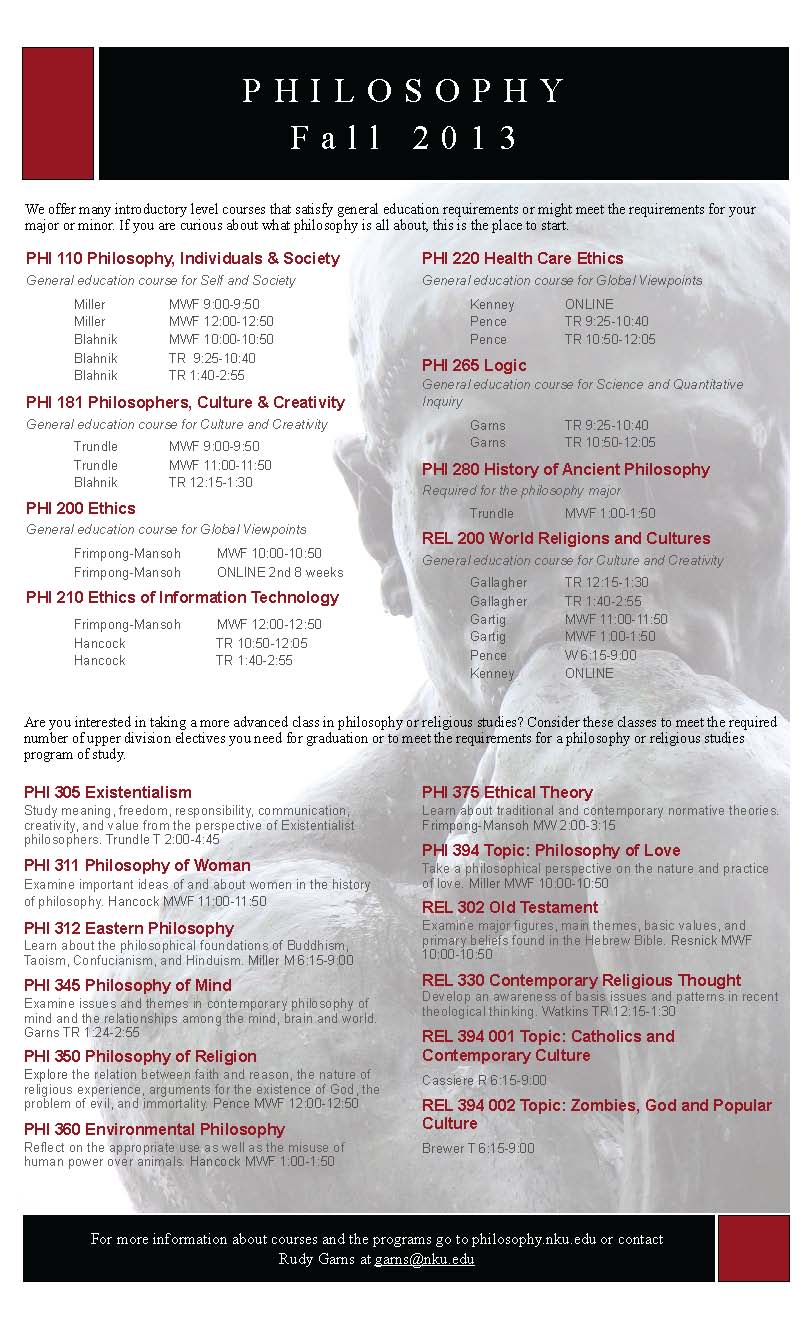
Fall 2013 Schedule

Our PHI / REL fall 2013 schedule is here. In the fall we offer our usual array of lower division general education classes as well as a variety of upper division elective and required courses. You are sure to find something that interests you.

Tuesday, March 05, 2013

Film and Philosophy: A.I.

The Film and Philosophy series will screen and discuss Steven Spielberg's A.I. This Friday, March 8, from 3:00-6:00 in the Digitorium. See just how much a robot boy can feel love and abandonment (not to mention despair and angst).

Wednesday, February 27, 2013

Immanuel Kant and his Man-Servant Lampe

Very interesting blog on the end of Kant's life and his relationship to his man-servant, Lampe. Most of the information comes from Ehregott Andreas Wasianski's 1804 work, Immanuel Kant in seinen letzten Lebensjahren.
Wasianski pauses to describe the relationship between the two in some detail. He considers it important to do so, since Kant and Lampe had a falling out two years before the philosopher's death. The nature of the dispute is not entirely clear from what Wasianski is willing to report of it, but it leads to the servant's dismissal, in 1802, and inaugurates the period of Kant's decline and eventual death two years later.
Immanuel Kant and his Man-Servant Lampe - Justin Erik Halldór Smith

Monday, February 25, 2013

Can pills change our morals?

Molly Crockett
Could we change the way people respond to moral situations by manipulating their brain chemistry with antidepressant pills? Molly Crockett is a neuroscientist investigating this question.
It seems that if we can just wrap our heads around the idea that peoples’ attachment to their ideals is not fixed, but can change, we’re more likely to listen to each other. It’s unclear whether we will ever be able to create a “morality pill”—in part because we have yet to reach consensus on what is “moral” in the first place.4 And we still have a long way to go before we fully understand how brain chemistry shapes moral judgment and behaviour.5 But preliminary work suggests we ought to cultivate a healthy skepticism towards our own sense of right and wrong – it may well be vulnerable to factors below our awareness and beyond our control.
Can pills change our morals? | thInk

Sunday, February 24, 2013

Bertrand Russell on science, education and democracy

Bertrand Russell
Bertrand Russell contends that "science education — something that leaves much to be desired nearly a century later — is key to attaining a future of happiness and democracy." In his 1926 book Education and the Good Life Russell writes about the good life, science, democracy and the importance of education.

For the first time in history, it is now possible, owing to the industrial revolution and its byproducts, to create a world where everybody shall have a reasonable chance of happiness. Physical evil can, if we choose, be reduced to very small proportions. It would be possible, by organization and science, to feed and house the whole population of the world, not luxuriously, but sufficiently to prevent great suffering. It would be possible to combat disease, and to make chronic ill-health very rare. … All this is of such immeasurable value to human life that we dare not oppress the sort of education which will tend to bring it about. in such an education, applied science will have to be the chief ingredient. Without physics and physiology and psychology, we cannot build the new world.

Bertrand Russell on human nature, construction vs. destruction, and science as a key to democracy | Brain Pickings

Wednesday, February 20, 2013

Philosophers' Cafe Topic: Gun Violence

“Gun Violence: A Philosophical Debate” is our topic at the next Philosophers' Cafe. Friday, February 22, 3:00-4:00 in GH 316.

Friday, February 15, 2013

Consciousness Conference Online

Are you  interested in the philosophy of mind and the nature of consciousness? You might want to check out this online conference. It begins February 15 at noon. You can browse the papers and the comments, including the activity from previous conferences.
The conference begins on the third Friday in February and runs for two weeks (that being ‘the conference’). Those presenters who allow it have their papers posted online at least a week before the conference begins so that people can read as many papers, in as much detail, as they choose beforehand to enhance and deepen discussion. During this two weeks discussion takes place in the comments section of each session (i.e. each post). It is much like blogging, only during a specific two week period. As such it can be done from anywhere at any time! After the conference the comments section will be closed (unless requested to be left open by author). Presentations, videos, papers, etc and discussion are left for people to view (unless the presenter requests otherwise) but no new comments are approved.
Consciousness Online